
Learn how to collect, store and use rainwater efficiently with RotoTank’s comprehensive Rainwater Harvesting Guide. Whether you’re a homeowner, farmer or business owner, this guide explains how rainwater harvesting systems work, their benefits, installation considerations and how to choose the right water storage tank.
As water restrictions continue across South Africa, rainwater harvesting has become one of the most effective ways to improve water security. By collecting and storing rainwater during the rainy season, homes, farms and businesses can reduce their reliance on municipal water while ensuring a reliable backup supply throughout the year.
In addition, RotoTank’s durable, UV-stabilised water tanks are designed to provide long-lasting performance in South African conditions. Whether you’re installing a complete rainwater harvesting system or upgrading your existing water storage, our solutions help maximise every drop of rainwater.
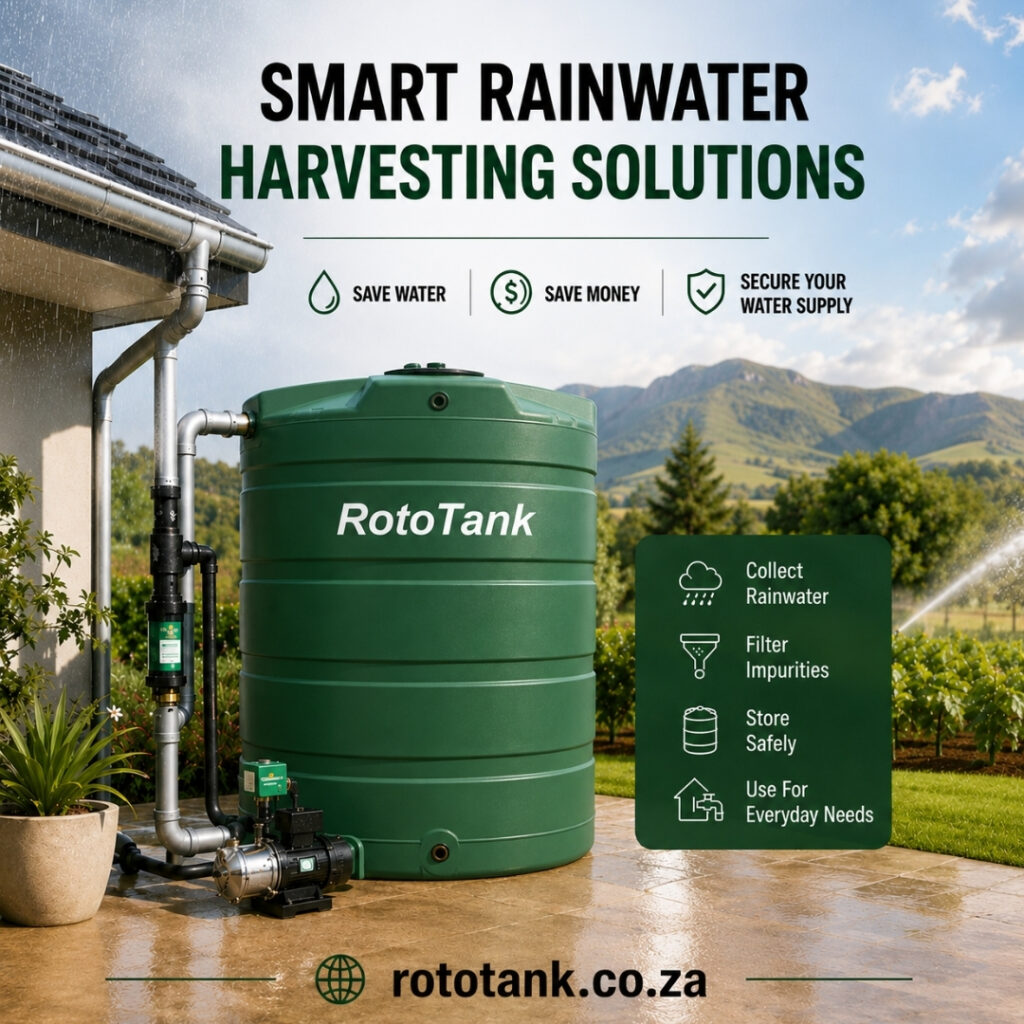
Rainwater harvesting is the process of collecting, filtering, storing and reusing rainwater that falls onto roofs and other suitable surfaces. Instead of allowing valuable rainwater to flow into stormwater drains, it is captured through a gutter system and directed into a water storage tank for future use. As a result, homes, farms and businesses can reduce their reliance on municipal water while improving water security.
A complete rainwater harvesting system typically includes gutters, downpipes, a leaf catcher or first-flush diverter, filtration components, a RotoTank water storage tank, and, where required, a water pump to distribute stored water throughout the property. Depending on the system design, harvested rainwater can be used for garden irrigation, flushing toilets, washing vehicles, cleaning, agricultural applications and other non-potable purposes. Furthermore, with the correct filtration and treatment system, harvested rainwater can also be made suitable for potable (drinking) water where local regulations and water quality standards are met.
Whether you’re installing a rainwater harvesting system for your home, farm or commercial property, choosing the correct tank size, filtration equipment and installation method is essential for achieving the best performance and long-term reliability.

| Household / Use | Recommended Tank Size |
|---|---|
| 1 – 2 People | 2500 L |
| 3 – 4 People | 5000 L |
| 5 – 6 People | 10000 L |
| Large Home / Small Holding | 15000 L – 20000 L |
| Farms / Commercial Use | 20000 L and higher |
*This is a guide only. Actual usage may vary depending on your needs.
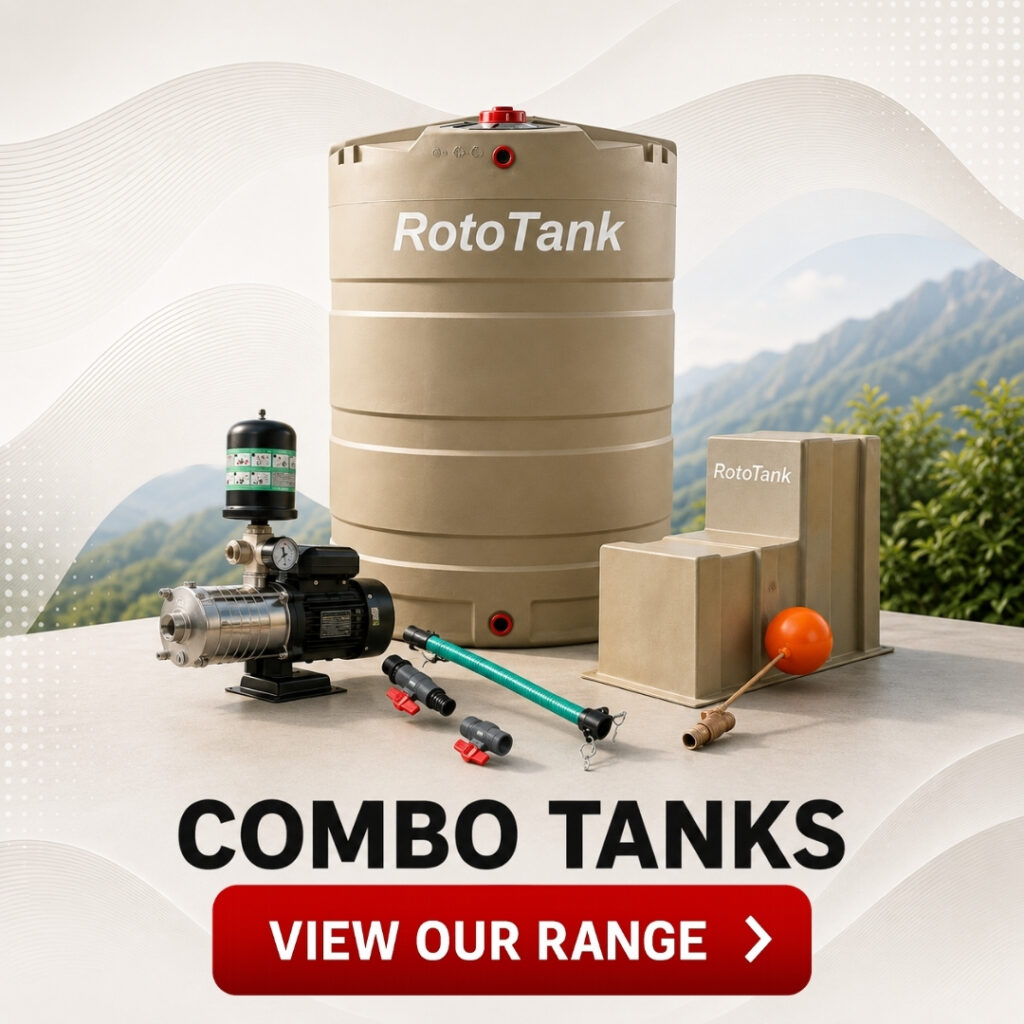


Rainwater flows from the roof into gutters and downpipes before passing through a leaf catcher or first flush system. The filtered water is stored in a rainwater tank and can then be distributed using gravity or a water pump.
Harvested rainwater can be used for:
With appropriate filtration and treatment, it can also be used as drinking water.
Yes. Rainwater harvesting is legal throughout South Africa and is encouraged as a sustainable way to reduce pressure on municipal water supplies.
The right tank size depends on:
Many homes choose tanks between 2,500L and 10,000L, while farms and businesses often require larger storage capacities.
Rainwater can be used for drinking if it is properly filtered and treated using suitable filtration and purification systems. Untreated rainwater should not be consumed.
A first flush system diverts the first flow of rainwater, which often contains leaves, dust and other contaminants, away from the storage tank to improve water quality.
Water tanks should be inspected regularly and cleaned when necessary. The frequency depends on water quality, environmental conditions and how the stored water is being used.
Water tanks should be installed on a level, compacted and fully supported base. A properly prepared base helps prevent unnecessary stress on the tank and ensures long-term performance.
Using a quality tank with an anti-algae black inner layer, keeping the tank sealed and preventing sunlight from entering the stored water can help reduce algae growth.